
Collier County Jail Mugshots Overview
Booking photos in Collier County come from the Sheriff's Office. When a person is booked at the Naples or Immokalee jail center, staff take a photograph as part of intake, and that image becomes part of the public arrest record. The Sheriff's Office says directly that mug shots and arrest information are public record. The official place a photo appears is the county arrest database, alongside the name, booking date, and charges, and the county's CCSO2go app shows the same arrest log with a photograph.
How long a photo stays visible is not spelled out in the official sources. The Sheriff's Office supports a same-day arrest report and prior-date searches, and the app advertises a ten-year arrest history, but no public page sets a fixed window for how long a released person's photo remains online. Because of that, the honest answer is that the county does not publish a removal-after-release timer, and a records request is the route for an official copy.
Where to Find Collier County Booking Photos
The official starting point is the Sheriff's Office arrest and warrants search, which carries a today's-arrest-report screen and prior-date searches. The today's-arrest report is the closest thing to a recent-bookings feed.
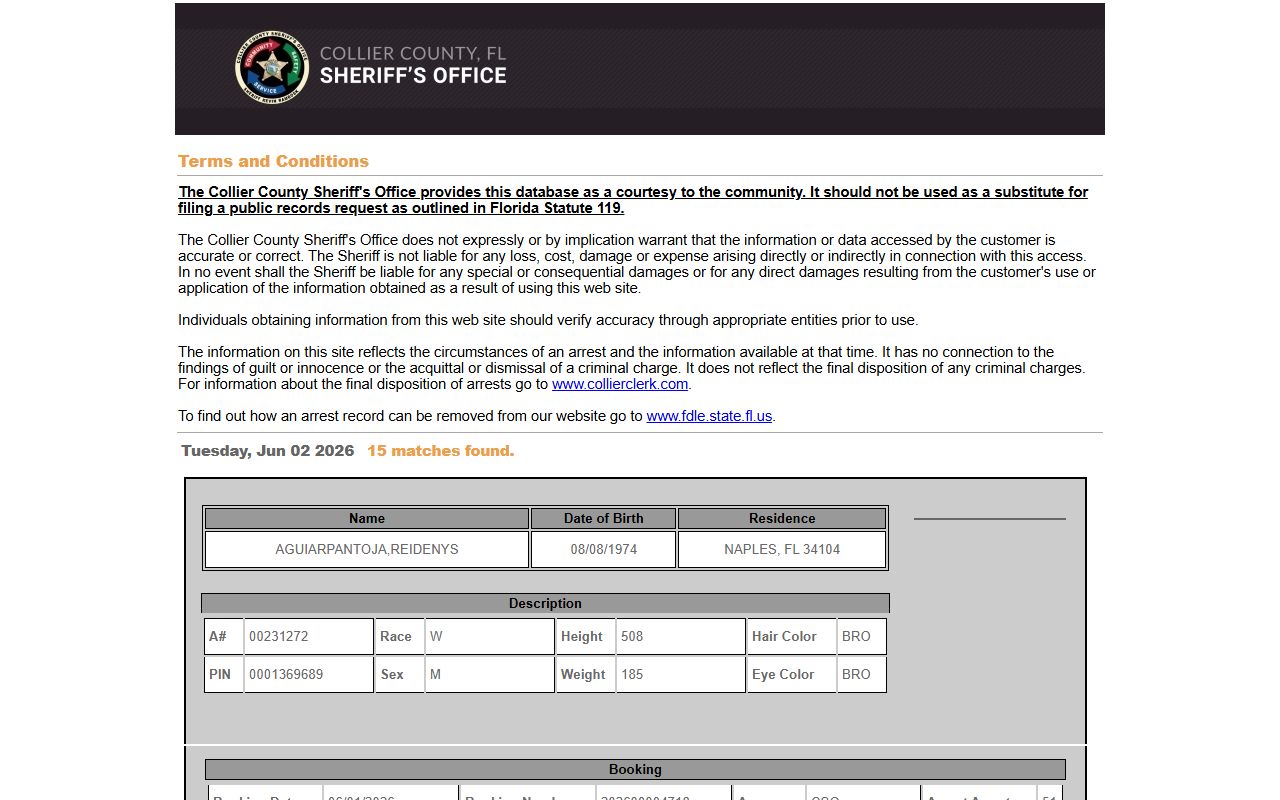
If the photo you need is not online, the fallback is a public-records request to the Sheriff's Office Central Records Bureau for the adult arrest record. The steps below cover both paths.
- Open the Collier County Sheriff's Office arrest search and use the today's-arrest-report link, or accept the terms for a prior date.
- Search by name, or by booking date if you know it.
- Open the result to view the booking photo and the arrest details shown with it.
- If the photo is not online, file a public-records request with the Central Records Bureau for the adult arrest record.
The county's roster and app are the official photo channels. Avoid commercial mugshot sites, which the Sheriff's Office does not use and which fall under separate Florida restrictions.
What a Collier County Booking Photo Shows
A booking photo never stands alone. It sits with the arrest-stage fields the county treats as public. The Sheriff's Office confirms the photo, the name, the booking date, and the charges, and the CCSO2go app adds a ten-year arrest history. Some live profile details could not be captured in full, so only documented fields are listed below, with the photo field highlighted.
| Field | What It Shows |
|---|---|
| Booking Photo | The intake photograph, treated by the county as public arrest information. |
| Name | The arrested person, searchable on the portal and the app. |
| Booking Date | The date the arrest was recorded, a confirmed search field. |
| Charges | The charges at arrest, shown in the arrest log. |
| Arrest History | Up to ten years of Collier County arrest history in the app. |
For the full custody record behind a photo, the jail inmate records page covers the roster fields and the access channels in detail.
Collier County Booking Photos in the CCSO2go App
The Sheriff's Office runs a second official photo channel through its free CCSO2go mobile app. The app carries an enhanced arrest log that searches by date or name and shows each arrestee's charges, a Collier County arrest history going back ten years, and a photograph. For a phone user, or for anyone who finds the web portal hard to navigate, the app is often the easier route to a recent booking photo. Apple App Store and Google Play links sit on the Sheriff's Office app page.
The app is a lookup tool, not a records service. It shows arrest-stage photos and charges, the same public arrest information the web portal carries, and it does not replace a formal public-records request for an official copy. No official page says the app offers a warrant search, so treat it as an arrest-log and photo channel rather than a warrant tool.
Are Collier County Jail Mugshots Public Record?
Yes. In Florida, arrest information including booking photos is a public record, and the Collier County Sheriff's Office applies that rule plainly. Its arrest-photo page states that mug shots and arrest information are public record and can be removed only by a statutory exemption, a court order, or expunction, regardless of how the case turns out. Florida's broad public-records law is the backbone, and a separate expunction statute is the main way a record comes down. The statutes below set the frame.
Key Statutes:
Florida Statutes § 119.07 - Requires record custodians to allow inspection and copying of public records, including arrest information and booking photos, unless an exemption applies.
Florida Statutes § 943.0585 - Sets the court-ordered expunction process, one of the few legal ways a booking photo and arrest record are removed.
How Long a Mugshot Stays on the Roster
The county does not publish a set time. The arrest search shows today's report and prior bookings, and the app keeps a ten-year arrest history, but no official page promises that a photo drops off a fixed number of days after release. Treat the online image as arrest-stage information that may stay visible, and use a records request when you need an official copy or confirmation.
What is and isn't public: The booking photo, name, booking date, and charges are public arrest information the county can show online. Final case outcomes are not on the arrest side; those live in the court record at the Clerk of Court. A photo comes down only through a statutory exemption, a court order, or expunction, not because a case was dropped.
How to Request a Collier County Booking Photo
When a booking photo is not visible online, the official copy comes from the Sheriff's Office Central Records Bureau through a public-records request. Requests can be made online or by mail to the Central Records Bureau at 3319 Tamiami Trail East, Naples, FL 34112, and questions go to 239-252-0637. The bureau is open Monday through Friday, 8 a.m. to 5 p.m., except county holidays. A related local arrest-background check costs $10, requires the person's name and date of birth, requires the subject to be at least 18, and takes about three to five business days. By mail, include a check or money order, never cash.
Two routing tips save time. The request can be made online through the Sheriff's Office records page or by mail, and general questions go to 239-252-0637. The Clerk of Court is not the custodian for arrest photos or booking records, so a mugshot request sent there is redirected to the Sheriff's Office. If you need a certified arrest record for a legal matter, say so in the request, and allow the standard processing time before following up.
Mugshot Removal and Sealed Records
The county will not take a booking photo down just because a case ended well. The Sheriff's Office states that removal requires a Florida Statutes Chapter 119 exemption, a court order, or expunction, regardless of the case outcome. That means a dismissal or an acquittal by itself does not erase the photo. The real route is a records-clearing process. The Florida Department of Law Enforcement runs the seal-and-expunge steps, and the court issues the order. To understand the difference between sealing and expunction and how an eligible case qualifies, see sealing and expunging an arrest record.
Commercial mugshot-publishing and pay-to-remove sites are a separate problem and are not used or endorsed here. Florida law restricts fee-based removal practices, and the records-clearing route through the court and the Florida Department of Law Enforcement is the legitimate path.
Why a Collier County Booking Photo Does Not Prove Guilt
A booking photo marks an arrest, nothing more. The Sheriff's Office says its arrest information reflects the circumstances of the arrest and the data known at that time, and that it has no connection to a finding of guilt or innocence, an acquittal, a dismissal, or the final outcome of a case. A photo can stay public even after charges are dropped, because removal follows a legal process, not the result of the case.
That gap between an arrest photo and a court outcome is why the booking photo and the court record should never be read as the same thing. To see what actually happened to the charges, the case file at the Clerk of Court is the source. A mugshot answers whether someone was booked, not whether they were ever convicted.
Collier County Booking Photo Terms
A few short definitions clear up the language around booking photos and how one comes down.
- Booking photo
- The intake photograph the Sheriff's Office treats as public arrest information.
- Public record
- Information the public may inspect and copy under Florida law unless an exemption applies.
- Exemption
- A statute that shields a record from release, one of the few ways a photo is withheld.
- Expunction
- A court-ordered process that can destroy or restrict an arrest record and its photo.
Federal and State Booking Photos
The county booking-photo rule does not carry over to federal custody. The Federal Bureau of Prisons does not post booking photos in the county-roster style, and the ICE detainee locator is a custody-status tool, not a photo gallery. So a federal or immigration case will not show a public mugshot the way a county arrest does. State custody is different again. Once a person is sentenced to the Florida Department of Corrections, the statewide inmate locator carries a photograph, but that is the state prison system, separate from the Collier County jail roster and its arrest photos.