
Collier County Court Records After a Jail Arrest
After a jail arrest in Collier County, two records exist side by side. The Sheriff's Office holds the arrest record, with the booking facts and the charges an officer noted at the scene. The court record is different. It opens when the State Attorney for the 20th Judicial Circuit reviews the case and files formal charges, and the Collier Clerk of Court keeps that file. The Sheriff's Office says outright that its arrest database does not show final disposition and points people to the Clerk for outcomes. So the court records after an arrest are the place to learn what actually happened to the charges.
The booking side and the court side serve different questions. For who is in custody and the booking detail, the jail inmate records page covers the roster, and the jail mugshots page covers booking photos. This page stays on the court record: the charges the prosecutor filed, how they change, and how the case ends. Keeping the arrest and the court record separate is the single most useful habit when you search.
How to Find Collier County Court Records After an Arrest
The court record lives with the Collier Clerk of Court, not the jail. The Clerk's online case search covers criminal, civil, probate, and traffic cases, and the public view needs no registration and charges no fee to look.
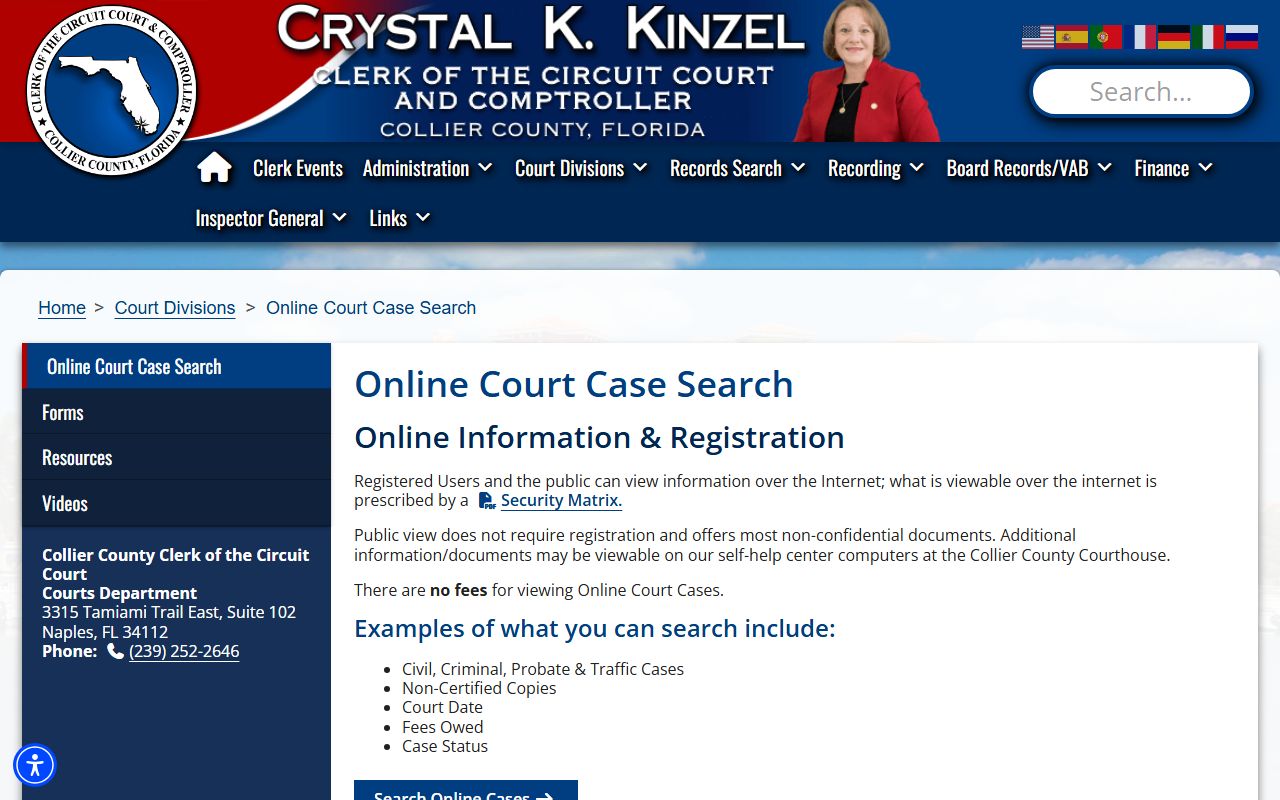
From that page, the public moves into the Clerk's court-record portal to read the docket and the charges. The portal is where a case is opened and read.
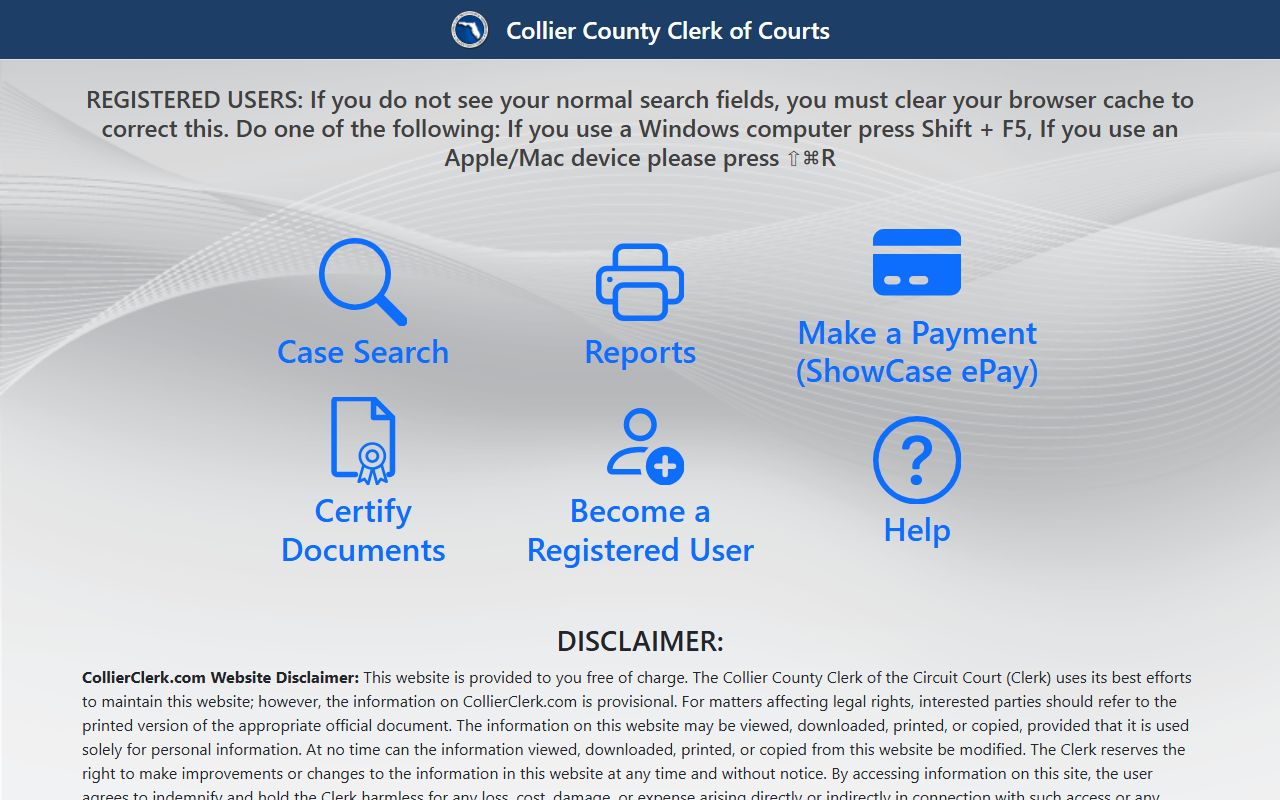
- Open the Collier Clerk online case search and choose the criminal case category.
- Search by the defendant's name, or by case number if you have one.
- Open the case and read the charge list filed by the State Attorney.
- Check each charge's status, the court date, and any fees owed.
Public view offers most non-confidential documents, and a few more may be available on the self-help computers at the Collier County Courthouse. For sheriff-created arrest narratives or booking records, the request goes to the Sheriff's Office, not the Clerk, since the two offices keep different records.
How Charges Get Filed After an Arrest: Complaint, Information, and Indictment
The path runs from the street to the courthouse. An arrest leads to a booking at the jail. The court record then begins when a charging document is filed. In Florida the prosecutor is the State Attorney, and Amira D. Fox holds that role for the 20th Judicial Circuit, which includes Collier County. Her office reviews what law enforcement submits and files the charges the evidence supports. There are three main charging documents.
| Complaint | Information | Indictment | |
|---|---|---|---|
| Filed By | Officer / Prosecutor | State Attorney | Grand Jury |
| Common For | Some misdemeanor and initial filings | Many Florida felonies and misdemeanors | Serious felonies |
| Starts | The case | The case | The case |
This is why a booking charge can differ from the charge in the court file. The officer records a charge at arrest, but the State Attorney decides what to file, and the court record reflects that decision rather than the first label.
Charge Status and What It Means
Charges do not stay frozen. As a case moves, a charge can be amended, reduced, added, dropped, or dismissed, and the court record shows each step. The booking charges on the jail side can look different from the charges the State Attorney finally files. The terms below show up in a Collier court file, and knowing them keeps you from misreading a case.
| Status | What It Means |
|---|---|
| Pending | The case is open and not yet resolved. |
| Amended / Reduced | The charge was changed after filing, sometimes lowered to a lesser offense. |
| Dismissed | The court or prosecutor ended the charge. |
| Nolle Prosequi | The prosecutor chose not to pursue the charge any further. |
If a document is not online, the Clerk's request-a-document page lists examples such as a booking sheet, court orders, and a judgment and sentence. Copies cost $1 per page, and a certified document adds $2.
First Appearance and Pretrial Supervision
Between the arrest and the filed charges sits the first appearance. A judge reviews probable cause, sets bond, and decides release conditions, usually within a day of booking. Some defendants are released on pretrial supervision, a program the Sheriff's Office describes as court-ordered release for people who qualify, with or without a money bond. Participants must follow every condition the court sets, which can include no-contact orders, check-ins, or treatment. That is why one person can leave custody without posting cash while another with the same charge stays in the pretrial population.
These conditions shape the court record that follows. A no-contact order, common in domestic and victim cases, can block jail visits even when a visitor sets up an account, and a violated condition can bring a bench warrant and a fresh booking. Reading the case file at the Clerk is the way to see which conditions a judge imposed and whether they still stand.
Who Keeps Collier County Court Records
Two offices split the records, and sending a request to the wrong one wastes time. The Collier Clerk of Court is the custodian for filed court documents, court dates, judgments, and final dispositions. The Clerk's courts department sits at 3315 Tamiami Trail East, Suite 102, in Naples, reachable at 239-252-2646, with Crystal K. Kinzel as Clerk of Court and Renata Robbins as the public-records coordinator. Adult arrest records, incident reports, and crash reports are not the Clerk's to give, and those route to the Sheriff's Office Central Records Bureau instead.
For a court document, search the online case index first, since it may already be public at no cost. If a filing is not online, the Clerk's request page handles it by email, with criminal and traffic requests going to one address and civil, probate, or family requests to another. Copies run $1 per page, and a certified document adds $2. A few records that are kept out of the public online view may still be viewable on the self-help computers at the Collier County Courthouse.
The Clerk's request-a-document page lists sample filings such as a booking sheet, court orders, and a judgment and sentence.
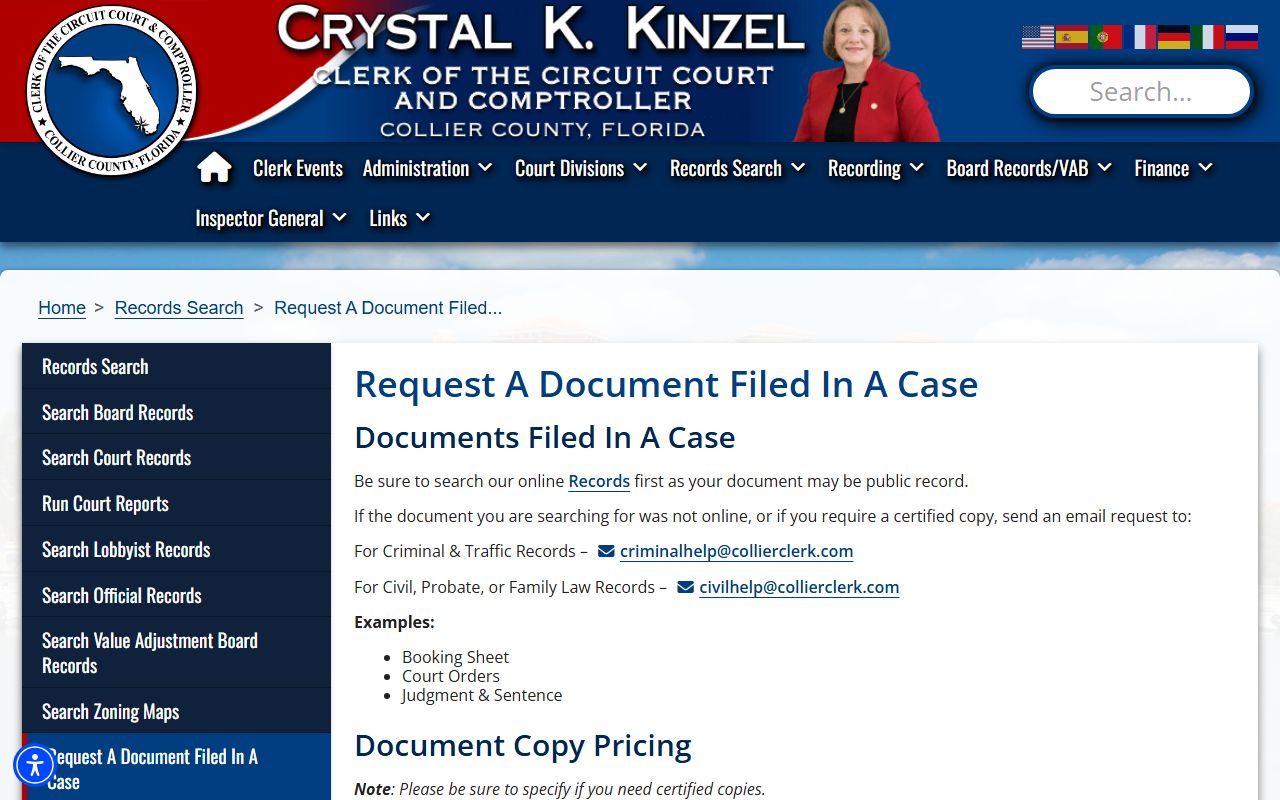
Specify on the request whether you need a certified copy, since the certification fee is added per document and the request is handled by email rather than instantly online.
Bond and Release After an Arrest
Bond is set at first appearance, where a judge reviews probable cause and release conditions. The Collier County Sheriff's Office lists three ways to post bond: cash for the full amount, a cashier's check for the full amount, or a surety bond through a licensed bonding company. Some people are released on pretrial supervision instead, a court-ordered program with conditions, with or without a money bond. A hold can keep someone in custody even when a bond figure shows online.
| Bond Type | How It Works |
|---|---|
| Cash Bond | The full required amount is paid directly to the jail. |
| Surety Bond | A licensed bonding company posts the bond for the defendant. |
| Pretrial Supervision | Court-ordered release with conditions, with or without monetary bail. |
| No-Bond Hold | A detainer, warrant, or court order blocks release even if a bond is listed. |
Note: An ICE detainer, an out-of-county warrant, or a no-contact order can stop a release, so confirm holds with the jail before paying any bond.
Warrants That Lead to an Arrest
Many arrests start with a warrant. An arrest warrant authorizes police to take someone into custody, and a bench warrant is issued by a judge, often after a missed court date or a violated condition. Both can land a person in the Collier County jail and open a new court record. To check for an active warrant, the Sheriff's Office runs the same arrest and warrants search used for bookings, and bench warrants tied to a case can appear in the Clerk's court docket. The portal terms remind users the data is a courtesy and should be verified. Anyone who believes they have an open warrant should not rely on a website alone, and should reach the court or an attorney.
Charges vs. Convictions
An arrest and a charge are accusations. A conviction is a result. The Sheriff's Office stresses that its arrest data has no link to guilt, innocence, or final disposition, which is the legal version of the same point. The table sets the two apart.
| Charge | Conviction | |
|---|---|---|
| Stage | Accusation | Verdict or plea |
| Burden of Proof | Probable cause | Beyond reasonable doubt |
| Public Record | Yes | Yes |
Florida courts can also withhold adjudication, where a judge stops short of a formal conviction even after a plea or finding. That is one more reason the court record, not the arrest entry, settles what a case really means.
Sealed vs. Expunged Arrest Records
After a dismissal or an eligible outcome, Florida law offers two ways to clear a record, and they are not the same. Sealing hides the record from public view while leaving limited access for certain agencies. Expunction goes further, with the record destroyed or treated as if it never existed. Both run through a court process, and the Florida Department of Law Enforcement handles the seal-and-expunge steps. The expunction statute, Florida Statutes section 943.0585, sets the court rules.
| Sealed | Expunged | |
|---|---|---|
| Visibility | Hidden from public | Destroyed or treated as never existed |
| Law Enforcement | Limited access | Very limited access |
| Eligibility | By Florida statute and court order | By Florida statute and court order |
Background Check Considerations
A casual name search is not the same as a regulated background check. Formal screening for jobs, housing, or credit must follow the Fair Credit Reporting Act and use a licensed consumer reporting agency. Court records you read on the Clerk's site are public, but using them to make those decisions is governed by federal law.
Important: This site is not a consumer reporting agency under the FCRA, and its content may not be used for employment, housing, credit, or insurance screening.
Restricted Court Records After an Arrest in Collier County
Not every record sits in plain view. Juvenile matters, sealed charges, and some dismissed cases are limited or removed from public access, and confidential filings stay off the public portal under Florida's records exemptions. The Clerk's public view follows a security matrix that decides what an unregistered user can see, which is why a few documents only appear on the courthouse self-help computers. For a sealed or expunged record, the route is the court and the Florida Department of Law Enforcement, not a request to the Clerk to simply take a page down.